


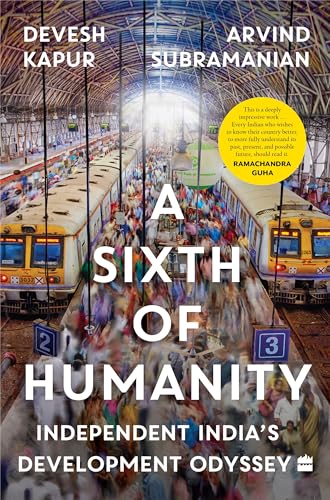
A Sixth Of Humanity: Independent India's Development Odyssey: Independent India's Development Odyssey /Devesh Kapur
Material type: TextPublication details: Gurugram: HarperCollins Publishers India, 2025.Description: xxi, 762p. ; 23cm. illustrationISBN:
 - 978-9369891092
- 338.954 K23S
| Item type | Home library | Collection | Call number | Materials specified | Status | Date due | Barcode | |
|---|---|---|---|---|---|---|---|---|
 Books
Books
|
RCL | Political Science Department Books | 338.954 K23S (Browse shelf(Opens below)) | Available | 65563 |
A Financial Times Book of the Year (2025)
India's journey has been distinctively 'precocious' in comparative terms. It opted for democracy before development and social change, promoted high-skilled services before and over low-skilled manufacturing and chose a globalization that favoured exports of talented people and short-changed the poor. The socialist state became an inefficiently capitalist one before providing the public goods of physical infrastructure and human capital. The outcomes have been surprising, with the country achieving success in creating and sustaining democracy, albeit flawed, and maintaining a modicum of order.
Four decades of economic dynamism and the emergence of a somewhat more capable Indian state has meant that it is able to build infrastructure and deliver the essentials of life to its population at scale-still not without disappointments, but a massive improvement over the past. Just as India's aspiration has lifted to building 'world-class' statues, temples, bullet trains, airports and digital systems, the undermining of some of the real achievements of democracy, federalism and nation-building stand in the way.
As the world gets radically upended, India's development odyssey is at a critical juncture. A Sixth of Humanity is an attempt to trace how one of the largest and most diverse countries in the world, uniquely and daringly, attempted four concurrent transformations-building a state, creating an economy, changing society and forging a sense of nationhood-under conditions of universal suffrage.
Jointly written by political scientist Devesh Kapur and economist Arvind Subramanian, both of whom have decades of academic and policy experience, this book encompasses perspectives that span disciplines, experiences and geographies. Rigorously researched, carefully argued and lucidly written, this is the definitive development history of India. There is no book remotely like it.
There are no comments on this title.