


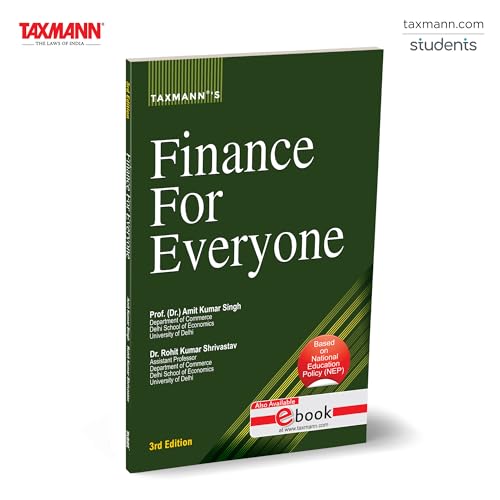
Finance For Everyone / Amit Kumar Singh, Rohit Kumar Shrivastav
Material type: TextPublication details: New Delhi: Taxman Publication, 2025.Description: 10.29p,+P.6, ; 24cm. illustrationISBN:
 - 9789371260558
- 332 SI50F
| Item type | Home library | Collection | Call number | Materials specified | Status | Date due | Barcode | |
|---|---|---|---|---|---|---|---|---|
 Books
Books
|
RCL | Management studies Department | 332 SI50F (Browse shelf(Opens below)) | Available | 65937 | |||
|
Books
|
RCL | Management studies Department | 332 SI50F (Browse shelf(Opens below)) | Available | 65938 |
Financial Literacy & Planning
Basics of financial literacy, its importance, and prerequisites
Personal budgeting, planning, and the art of managing inflows/outflows
Understanding financial institutions and their role in financial inclusion
Banking Services
Overview of different types of banks, deposit accounts, loans, and online banking
PAN card, KYC norms, CIBIL scores, and maintaining healthy credit
E-banking, RTGS, NEFT, IMPS, and the cashless banking system
Financial Services from Indian Post Offices
India Post Payment Bank and its range of services
Various Post Office savings schemes (Kisan Vikas Patra, NSC, PPF, Senior Citizen Savings Scheme, Sukanya Samriddhi Yojana, etc.)
Money transfer and remittance facilities
Insurance Services
Life insurance (term plans, endowment policies, pension policies, ULIPs) and health insurance
Property insurance products
Postal life insurance schemes and related products
Stock Market Basics
Primary and Secondary markets, IPOs, FPOs, shares, debentures, mutual funds, derivatives, etc.
Stock exchanges in India, understanding stock indices (SENSEX, NIFTY)
Tax implications (short-term vs. long-term capital gains)
Each unit culminates in practical exercises encouraging learners to explore banks, insurance companies, and post offices, collect information, compare policies, and compile personal budgets
The structure of this book is as follows:
Learning Outcomes – Each chapter begins with learning outcomes to give brief context about the content and what the readers will achieve after the successful completion of the chapter
Main Text – Various concepts and topics have been explained in simple and lucid language
Examples & Cases – They are added to each chapter to enhance readers understanding
Practice Questions – Each chapter provides a list of questions to test the readers' knowledge. Readers can answer these questions to review their learning
Activities – The benefit of learning finance concepts cannot be fruitful unless applied to practical situations. Thus, each chapter offers activities for readers to ensure learning by doing
Finance For Everyone simplifies essential finance principles for undergraduates in all fields, fully aligning with NEP guidelines. It uses clear language, real-life examples, and hands-on exercises to nurture financial literacy and independence. Structured in five units—from budgeting and banking to insurance and the stock market—each chapter includes concise learning outcomes, practical case studies, and practice questions. This highly accessible guide suits students, educators, self-learners, and professionals eager to strengthen their personal finance knowledge.
English.
There are no comments on this title.